
Blog
Beyond Matter: Universal Consciousness, the Subconscious Mind, and Human Behavior

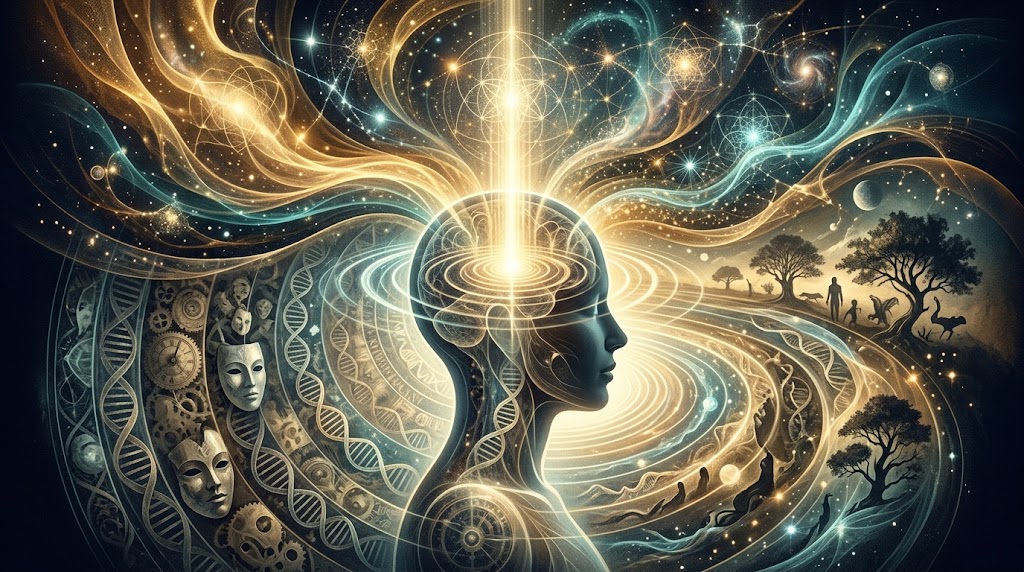
An essay on the central thesis of The Unfolding Oneness: A Journey Through the Mysteries of Consciousness, available on Amazon.
In the operating room, the anesthesiologist asks you to count backward from ten. You hear yourself say nine, eight, perhaps seven—and then a moment arrives that cannot be described, because no one was there to describe it. When you open your eyes four hours later, you discover a startling fact: your brain never stopped working. Neurons kept firing, and your cortex kept consuming energy. What was interrupted was something else entirely: the felt presence from the inside—the sense that it felt like being you.
This everyday clinical boundary is where The Unfolding Oneness begins. Across twenty-two chapters, the book confronts a question that has resisted every attempt by mechanism or dismissal to close it: is consciousness a late, accidental byproduct of complex matter, or is consciousness the primary ground in which matter itself appears?
At the heart of the book lies the thesis of Universal Consciousness (the One Consciousness)—an account that reverses the standard materialist direction of explanation. It connects four foundational principles:
-
- the priority of consciousness over matter, across all living and inanimate things;
-
- the unity of all localized awareness within a single Universal, or Divine, Consciousness;
-
- the parallel accumulation of the subconscious mind from birth;
-
- the shaping of human behavior by how much territory Universal Consciousness reclaims from the subconscious.
1. Consciousness precedes matter: individual awareness across all existence
Since Galileo set subjective qualities aside so physics could become mathematical—a move philosopher Philip Goff calls Galileo’s error—modern thought has tried to build mind out of mute matter. David Chalmers gave this impasse its enduring name in 1994: the hard problem of consciousness, complementing Joseph Levine’s explanatory gap. Neuroscience excels at the “easy problems” of function—mapping how circuits sort wavelengths, guide limbs, or broadcast signals—yet a complete mechanical description still leaves unexplained why electrical and chemical activity should feel like the taste of an apple or the sting of pain. As I put it in the book: “The machinery is not the light.”
When the leading neural theories of consciousness—Integrated Information Theory (IIT) and Global Neuronal Workspace Theory (GNW)—were tested head-to-head in the landmark 2025 Cogitate Consortium adversarial collaboration across 256 participants, central predictions of both frameworks were challenged. Trying to conjure felt experience out of non-experiencing matter remains an unpaid explanatory debt.
The Unfolding Oneness proposes reversing the order of explanation: consciousness does not arise from matter; rather, consciousness exists prior to matter and prior to the emergence of creatures. Every entity in the cosmos—whether a living organism or inanimate matter—participates in a localized, partial aspect of consciousness that precedes its physical form.
Twentieth- and twenty-first-century physics has already dismantled the old picture of the world as a patchwork of wholly isolated local objects. John Bell’s theorem and loophole-free entanglement experiments, such as Ronald Hanson’s 2015 Delft test, show that nature cannot be explained by local hidden variables alone. Across scales—from Alan Turing’s reaction-diffusion morphogenesis and Benoit Mandelbrot’s fractals to coupled oscillators (from Christiaan Huygens to Yoshiki Kuramoto) and Ilya Prigogine’s dissipative structures—reality exhibits a deep relational grammar and an underlying order prior to any single material part.
2. Universal (Divine) Consciousness: one ocean, many waves
If every entity carries a partial aspect of awareness, how do those parts relate without falling into what William James in 1890 called the combination problem—the puzzle of how countless windowless specks of “mind-dust” could ever add up to a single unified subject? Rather than building a large mind from tiny pieces bottom-up (constitutive panpsychism), the book adopts a top-down framework (cosmopsychism): all localized parts of consciousness in the universe are interconnected within a single overarching awareness—the Universal Consciousness of Existence, or what many prefer to call Divine Consciousness.
My thesis is that consciousness is not merely ubiquitous but singular: what appears to be many separate awarenesses is one awareness under the conditions of embodiment, perspective, and time. Think of a wave—not as a small piece of ocean that merely resembles the rest, but as the ocean doing something locally. The Unfolding Oneness, Introduction
Living beings are brought into existence carrying an innate, pure share of this Divine Consciousness. On this view, the brain does not manufacture consciousness; it localizes, constrains, and organizes an awareness already present—much as an eye turns light into an image without creating the light, or a radio receiver tunes a broadcast without being the station. Damage to the receiver distorts the music, not because the radio generated the melody, but because it shapes how the signal is expressed locally.
3. The subconscious mind: how accumulations cloud the purity of Divine Consciousness
If living beings—and human beings foremost among them—are born with a pure spark of Divine Consciousness, why is ordinary human life so often marked by alienation, egoism, and conflict? The answer lies in a parallel process that begins at birth. Alongside the pure ground of Universal Consciousness, every living organism accumulates a subconscious mind—a constructed, constraining self-model—formed from three converging streams that divert the creature from its original clarity:
| Subconscious tributary | Mechanism in the book | How it diverts us from pure Universal Consciousness |
|---|---|---|
| 1. Genetics and biological drives | Evolutionary survival routines, bodily interoception, and inherited self-preservation codes. | Narrows awareness to the boundaries of the physical organism, turning a vehicle of expression into a survival-driven enclosure ruled by fear and impulse. |
| 2. Personal experience and memory | Predictive processing—the brain as a skilled guesser, or “controlled hallucination” (Clark, Friston, Seth)—and narrative identity (McAdams). | Filters the living present through accumulated past traumas, habits, and expectations, replacing direct awareness with a retrospective internal sketch. |
| 3. Environment, society and culture | Social conditioning, language, Thomas Metzinger’s transparent self-model, and Michael Gazzaniga’s left-hemisphere interpreter. | Hardens the illusion of a separate, bounded ego (“I”) standing apart from others and nature, fostering division, bias, and estrangement from the whole. |
Together, these three streams—genes, experiences, and environment—weave what Karl Friston calls a Markov blanket and sustain the brain’s Default Mode Network (DMN), the circuit active during self-referential rumination and mind-wandering. Because we are transparent to our own modeling, we mistake this accumulated subconscious mask for who we truly are, obscuring the pure Divine Consciousness beneath.
4. The equation of human behavior: the balance between Universal Consciousness and the subconscious
This framework carries direct consequences for understanding the behavior of living beings, and especially human beings. Human action is determined in the dynamic arena between these two poles—specifically, by how much space Universal Consciousness governs within the territory of the subconscious mind.
Neuroscience shows that a vast share of routine human behavior is initiated unconsciously before the narrating ego even notices. Benjamin Libet’s readiness-potential experiments, Chun Siong Soon’s fMRI decision studies, and clinical cases of blindsight show how unseen subconscious processes drive action while the “interpreter” invents explanations after the fact. Human conduct thus shifts along a clear spectrum:
-
- When the subconscious mind dominates and Universal Consciousness recedes: the individual acts as an automaton of genetic impulses, unexamined past conditioning, and social tribalism. Separation feels absolute, and selfishness, cruelty, and conflict follow naturally from a self-model built for isolated defense.
-
- When Universal (Divine) Consciousness expands its governance over the subconscious: through disciplined attention, honest self-inquiry (looking for the one who is looking), and the quieting of egoic rumination in the Default Mode Network, the subconscious layers are refined and made transparent.
As I conclude in the final chapter of The Unfolding Oneness, if one underlying awareness is the ground of all selves, cruelty is no longer merely a violation of an external rule—it is like harming a limb of the very organism one belongs to. Kindness, justice, and compassion cease to be obligations forced on naturally separate strangers; they become what clear perception looks like when you see the boundary between you and the other for what it is.
Conclusion: an invitation to look for yourself
The Unfolding Oneness does not ask the reader to trade materialist dogma for unexamined mysticism. Throughout its pages, it marks every claim in one of three registers: established fact, open hypothesis, or my reading.
The unfolding of oneness is not a distant future event. It is the ongoing reclamation of awareness from the accumulated noise of the subconscious—recognizing, here and now, that the awareness reading these words was never sealed inside an isolated skull, but is a living window of the One Consciousness that sustains the cosmos.